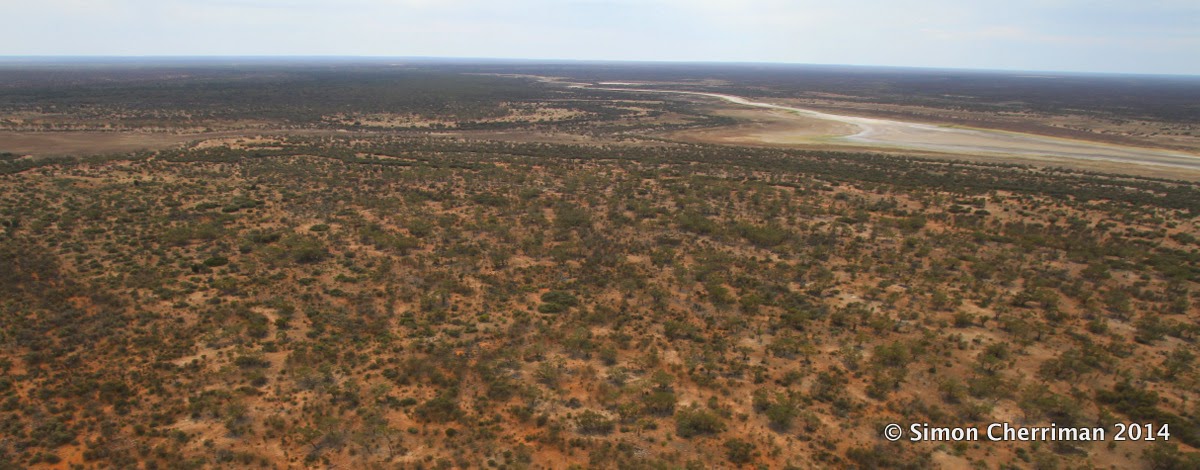
It's official! I'm thrilled to announce that Curtin Unversity's Department of Environment and Agriculture has made a donation to support this eagle tracking project. These funds will allow us to receive satellite tracking data for the next 12 months and follow what our three Wedge-tailed Eagles are up to. I completed my undergraduate degree at Curtin and have remained part of the Alumni family since graduating, so it's very pleasing to have their support. Thanks Curtin!
You can read more about other supporters of this project here.
It's been a while since you've heard anything from our adult eagles - the last update on Gidjee was nearly a month ago, and we haven't checked in on Wallu since early January. What has happened to our pioneering, PTT-bearing predators?
The above picture (click to enlarge) shows what it's like to be a few hundred metres above the ground on the border of Wallu and Wurru's home range, and that of their neighbours to the south. This photo was taken from a helicopter last year. The below screen capture shows what it's like to be Wallu at 3pm today: here, he's a mere 4000 m above sea level! I haven't written about our eagles' altitude data lately, but they are continuing to soar very high and give readings of up to 6000m asl, which provide evidence that the first seemingly unbelievable height of ~6500 m asl that Gidjee reached some months back was indeed accurate.
Spatially, Wallu is very much doing the same thing as he has for the past 11 months. Other than his walkabout in January, the beautiful breakaway country and woodland to the north and west of Lindsay Gordon Lagoon have clearly been too good to leave, and his movements have been restricted to 'prey hotspots' within this area. A wet start to the year has almost certainly helped with prey animal abundance, and it's highly likely that many waterbirds have been attracted to flooding of the two lagoons in Wallu's territory.
Interestingly, there seems to have been a shift in Wallu's key roosting sites in relation to two sections of lagoon (let's call them East Lake and West Lake - see the below maps). When we first tracked him last year, he showed a definite preference for the eastern edge of East Lake, and some scouting revealed that a well-used rabbit warren was probably the reason. Since the rain at the start of this year, Wallu has been recorded frequenting the whole northern shore of West Lake, which might well be due to an increase in rabbit numbers following rain, and the arrival of some tasty ducks and swans! A combination of both is quite likely.
Here's a map showing the large 'ring' of Wallu's favourite locations: the northern shore of West Lake (green circle), and the small cluster of points at the rabbit warren on the eastern edge of East Lake (black arrow). Click on the map to enlarge.
What about Gidjee? The sighting of her perched with Mulga about a month ago was very pleasing indeed, and you would think that not much could change in only a few weeks. However, every day is a new day, and one must never assume.
Gidjee has unfortunately gone missing. The day after her sighting, she unexpectedly left Lorna Glen and headed north-west, travelling 80 km in the three hours between 10am and 1pm. By that evening, she roosted 130 km from her territory, and I was hoping she'd return home the following day. But for the next 3 days, she wandered around this area, soaring and often spending quite some time at altitudes between 1000 and 2000 m. On the afternoon of 11th April she made another long flight north, settling to roost near a large clay-pan (which probably has water in it after such a good season).
The next day she left this roost at 8am, and flew 700 m to land, presumably to perch in a tree. This was the last time the PTT recorded movement for the next 10 days. Since then no new data has come through, and the PTT has subsequently switched off, which means it ceased to face upwards and charge properly. Here is a map showing the movements I've just described:
We still don't know what has happened to Gidjee. Unfortunately I won't have an opportunity to head out and investigate this any further until August, when I return from overseas. But currently there are two possible options: 1) she has been killed for some reason, perhaps as a result of being kicked out of her territory by another adult female eagle, or 2) the PTT has fallen off her back and landed in the desert, 195 km from Lorna Glen.
Keep watching Wedge-tailed Eagle Tracking to find out.
I've just returned from a 2 week field trip in remote Western Australia where intermittent internet access only just allowed me to keep in touch with Kuyurnpa's tracking data. Now it's time to give you an update!
In a remarkable journey that has now spanned nearly a month, this incredible wandering Wedge-tail has now flown over FOUR THOUSAND kilometres across the Gascoyne and Pilbara regions of outback Australia. She headed north from her natal territory and settled briefly on the Pilbara coast only a few hundred kilometres from the well-known tourist destination Broome, before returning back inland and exploring the vast parallel sand dunes of the Great Sandy Desert. Latest tracking data shows Kuyurnpa's roost somewhere between Karijini and Rudall River National Parks, south-west of the Great Sandy in the central Pilbara. This point is shown in the above picture, which you can enlarge by clicking the image. If you happen to be travelling in this area, keep you eyes out for an eagle with an aerial! And please get in touch and/or send photos if you happen to 'meet' out wonderful Kuyu!
Check out THIS! Kuyurnpa has moved an incredible distance, travelling just over ONE THOUSAND KILOMETRES in only the last 3 days! Her roost tonight is located 640km (as the eagle flies) from her natal nest. This is the longest distance ever recorded for the species in such a short time... previous records taken months apart showed the record distance from a banding site to a recovery site (where a juvenile has been resighted months later) to be about 800km. You can really get a sense of the distance moved by looking at Kuyurnpa's flight on an Australian scale.
More tracking news soon!
Today some good news came in from scientists working at Lorna Glen this month. They made sightings of Gidjee, Mulga AND Kuyurnpa over the last few days! It's always reassuring to get sight records of these birds to ensure they appear in good physical health, even though we can get a reasonable idea of how they are faring from the remote tracking data. Thanks to ecologist Dr. Colleen Sims, I'm able to show you a photo of Gidjee (who has a PTT) and her mate Mulga (untagged), perched near a very green wetland at Lorna Glen. This area is a low-lying patch of ground which was inundated several weeks ago, and the eagle family has been spending much time here, almost certainly because of the prey animals attracted to the water.
Here is a closer look at Gidjee's back - you can just make out the PTT and aerial on her back! Thanks heaps for the picture Colleen :)
Another day, another massive distance! Kuyurnpa is now really exploring far and wide from her birthplace, and over the last 6 days has covered an INCREDIBLE 1200kms! Her roost position tonight was near the north-western corner of Lorna Glen - but before reaching this point she had some travelling to do.
Kuyurnpa left the edge of Lake Carnegie (pictured centre right in the above map) on Wednesday morning and headed north, stopping overnight on what appears (from the aerial photographs) to be a patch of sand dunes, a distance of 200km. She then spent Thursday going south-west, roosting last night just south of a chain of wetlands, which probably still contain water considering the amount of rain which has fallen since January. Today she took of towards home again - does this mean she is heading back to see mum and dad again soon? In three days we will find out. Stay tuned!
Before I sign off - here's a map of Kuyu's movements on a much larger scale, showing the lower half of Western Australia. For the last 9 months we've had to zoom right in to the Lorna Glen study area to look at the small distances covered by our adults (except for Wallu's short walkabout back in January). Here Kuyurnpa is beginning to demonstrate how this species really is capable of covering huge distances in a relatively short space of time. She is just one of the (possibly hundreds) of juvenile wedge-tails who have fledged and begun their independent wandering period in WA this year. I wonder what the others are doing?
Our little girl has suddenly grown up! The latest and most exciting data from our satellite tracker on Kuyurnpa's back shows she has left home, and for the first time ever, roosted away from her parents' home range. This morning she was recorded in a tree near the south-west corner of the fenced enclosure, perched in a tree at 9 am. At 10 o'clock she had hardly moved, but when the GPS took its next fix at 1pm, she was soaring above a large salt lake nearly SIXTY KILOMETRES to the south!! Not long after she settled in this area and picked a roost site just east of the salt lake. Where will she go next?